Saturday, December 10, 2005

Richard Pryor, 1940-2005

vert.pryor.stood.ap

"I had some great things and I had some bad things. The best and the worst... In other words, I had a life.

You have to have lived some life. You've got to have paid some dues."

Friday, December 9, 2005

And a Twinkie shall lead them.

A great series-writing lesson from The O.C. last night.

(That's right. The O.C. Deal with it.)

Last night, they dropped early in the episode that Summer (the pretty airhead girlfriend to Seth "Mighty Brain" Cohen) scored 2300 on her S.A.T.'s

In a heartbeat, everyone's relationship to the character shifted.

Challenging what the audience and the characters in the show know about a character is one of the most effective ways to shake up and rejuvenate your series -- so long as its organic and believable within the context of the show.

In the case of The O.C. Summer has been "showing smart" for some time now. She's also a particularly American kind of smart: ie: innate intelligence combined with an appalling lack of actual knowledge or literacy.

It put me in mind of one of the things that I always found the most appealing about Seinfeld's Kramer -- the fact that this "hipster doofus" -- against all probability, was great with women.

Contradiction in a character is not bad. In fact, if it's done right, it's ooey, gooey good.

That 2300 S.A.T. score, I predict, will be the shot heard round The O.C. for the rest of the season.

The Scheduler as Ozymandius

UK writer Stephen Gallagher has credits that shame me in three mediums, including a stint writing Doctor Who, and an upcoming series he created starring Patrick Stewart called Eleventh Hour. Regarding my post on the "The End of The British Six Pack?" He writes:

"The six-pack was a great model. Once. When the UK only had two TV channels and there were no video recorders and the pace of life was such that six weeks went by like an ocean liner.

These days... a zillion channels, life far more hectic, most of our viewing timeshifted... six weeks is what it takes to become aware of a show, by which time it's over.

Right now the main obstacles to change here in the UK are the network schedulers, who are terrified at the size of the commitment involved in a 26-week run of standalone stories, and the producers, who baulk at the idea of stepping back while writers talk to each other.

The schedulers want someone to guarantee them that a show won't fail. Which can never happen. The US can meet this by making the shows just ahead of time so that cancellation only leaves you with a couple in the can.

The producers are used to micromanaging writers on a one-on-one basis and pretty much laying down what is and isn't going to play. In a roomful of writers, the non-writing producer is weakened. The US answer - structure the producing power within the room.

What the industry in the UK is hankering for right now is to make drama like HBO does it.
Memo to self: I have got to work on my brevity. Stephen just nicely encapsulated the major stumbling blocks that people like Jane Featherstone face trying to change the face of British Drama. And he did it in a few short paragraphs. Watch now, as I fail to do the same in my response.

Here in Canada, writers face a lot of the same obstacles, with a few peculiar quirks that are all our sweet own. But you do hear the HBO bogyeman trotted out with alarming regularity.

The problem with this idea -- both for UK creators and North Americans -- is that HBO works on an entirely different economic model than most of the commercial channels -- or even the publicly funded channels like Big Auntie Beeb and her sad, preemie little sis, the CBC.

At HBO they recruit top talent and they leave them alone, and get thirteen episode runs that rock. But. (There's always a but.) HBO is entirely a subscription service. They charge you 15 dollars a month, and they know that for a significant number of subscribers, intelligent, original series are the draw. But once they have your fifteen dollars, they don't even care if you watch. See, the series is the carrot. HBO uses ratings not to determine a program's success, but to determine if it's connecting with its subscriber base. It's more of a buzz-meter. All they care about is: will it get Emmy nominations (and thereby extend the prestige of the brand) and is it intriguing enough that it will help us retain subscriptions, and sign up new ones?

The HBO viewer is by no means an average viewer. They have more money, they're probably better educated -- and they're a way smaller pool. The Sopranos is brilliant, Six Feet intermittently so, and Sex & The City started a cultural quake: but though the ripples these series made is huge, the audiences that watched them were not. (It's not quite as cut and dried in Canada as the U.S. as Sex In the City, The Sopranos, and Six Feet have all played second run on either terrestrial or extended basic cable.) It's always struck me that chasing the HBO model show is a bit of a chimera. Instead, don't you need to develop from the bottom up? Ask who is your audience, and who would you like your audience to be, and how do you develop shows that would attract them?

To me, this is the real brilliance of the US networks. A FOX show is not a show that would appear on any other network. The WB took some early chances when everybody was ready to write off the idea of a fourth US net as a pipe dream, and it paid off. For years, NBC had a touch for developing comedy that no other network could match. This, I think, comes from knowing who your audience is and coming up with shows that can reach them. So, in everything but quality, when I start hearing the bleating about developing "HBO-like" series, my question is not, "aren't you aiming too high?" but "why are you aiming so low?"

When it comes to The Scheduler, the Canadian problem is a little more comical, or sad, depending on your point of view. The fact of it is, there really isn't a lot of indigenous production to schedule here. What schedulers from the networks do here is go down to the L.A. screenings, and cherrypick the best of what the U.S. nets have developed. So they get to bask in the reflected glory of creative risks taken by people other than them. Then they come back and schedule those shows, usually at the same time as their American network counterparts. That way, they get to piggyback on U.S. network publicity and magazine covers and promos and such. Then -- and here's the truly magic bit -- the CRTC (the Canadian telecommunications regulatory body) allows them to substitute their signal over the U.S. network signal for the duration of the simulcasted program. So their ads get double exposure! Yayyy! So, in other words, even their role as "scheduler" is a misnomer. Their job is to follow the US lead.

Yet...these people walk around Toronto like superstars. Because they're good shoppers. Seriously. I've been at the same parties, seen them up close in their natural habitats. It's like me expecting applause and praise for picking up a few choice items at HMV.

And it's kind of hard to argue against them, because broadcasting in Canada is a very profitable business. It's way cheaper to schedule US shows than it is to produce Canadian ones. And Canadians want to see these shows. And if it's doing absolutely nothing to slow the steady stream of talent to the United States, and doing nothing to actually develop a distinct culture of your own, well...so what? "Did you see the numbers CSI: Miami did last week? Aren't I brilliant?"

Um..well...maybe Les Moonves is brilliant. You just had a gold card.

There are signs of change here...there are LOTS of network people I have talked to here who are really committed to having homegrown hit shows. Corner Gas has made an impression. For years there was a shrug and a "Canadians don't want to watch Canadian shows." Now, once a week, one out of every thirty Canadians watch Corner Gas and prove that's a load of hooey. But the people who are toiling to try and find great scripts and develop a good show do not have the power in the organization that the shoppers do. Nowhere near. And in this system, with its anemic production culture, Canadian producers don't have a lot of power, either. Very little, actually. Strangely (and I know this is counter-productive to my goals) that almost makes me like them more.

The most positive change to come about -- and this is only in the last couple weeks -- is that the funding agencies here are switching to something called an "envelope system" for drama. Time was, you would get a go-ahead from a network, then apply to the Canadian Television Fund for financing (or part of your financing) and you could get turned down. So the network wants you...but you don't get your money because a bureaucrat decided your show wasn't "Canadian enough." (Don't get me started on that one.)

But now the system has changed. Henceforth, the networks will be apportioned a certain amount of money, and they can spend it as they wish -- so long as it's on drama or comedy. Which means that creators no longer have to do two sets of documents and proposals...you just have to sell the network.

Will this help? I don't know. Remains to be seen. It can't be worse than the current system. And it will do nothing to shame or clip the reign of the white wine sipping schedulers who stride high because they have the ability to buy American creativity at wholesale prices.

CBC, god love her, has her own problems. But the Schedulers there, too, walk around like mighty Ozymandius.

And they've made some colossally bad scheduling decisions lately. Like taking a comedy show that they launched last year to great fanfare called "Rick Mercer's Monday Report," and moving it to Tuesday.

I wish I was kidding.

Thursday, December 8, 2005

Jai guru deva om

Twenty-five years.
lennon_self_portrait
It's a little hard to believe. Still. Unlike the bloviating baby boomers who you'll mostly hear from today, I knew him as a child first -- and, funnily enough -- as a fellow New Yorker. Through words and interviews and snippets and those beautiful melodies I learned sarcasm and wit; passion and compassion; frailty and fault.

It's always pleased me that most of the fiction that's tried to capture what he's about: plays, Broadway Musicals, Films, and television -- have all fallen so incredibly, comically short.

Sometimes the artist just needs to speak for himself.

A lucky man, who made the grade, indeed.

Imagine

Wednesday, December 7, 2005

The End of the British 6-Pack?

Heh heh. I don't know why, but the idea of the "British 6-Pack" amuses me. Face it, we have to get a new joke -- the-making-fun-of-their-teeth thing went past the sell-by date years ago.

In this article at The Guardian website (yes, registration is required. but it's free, stop whining.) British TV Production Exec Jane Featherstone opines that the UK may finally have to move away from the six-pack... "We are going to have to start producing longer-running series," she says. "We are going to have to start the shift to US-style 26-part series..."

Here in Canada, of course, CBC is in love with the six-pack (cause, you know, that's what they do in the UK.) Featherstone's other point is that you have to make shows with broader appeal, that could sell overseas, even -- to make up the difference in budgets. That seems to be going in the opposite direction of CBC too, but who knows, now that a British person has suggested something different, things could change awfully quick here, too...

I think longer seasons are definitely better for building and maintaining writing careers, because as it stands, the UK is a lot like Canada in the sense that short runs of episodes tend to mean they only employ the writers who've created the shows. That's not good for training, and it's not good for building a larger community of professional writers. (I believe the situation, believe it or not, is actually a little better in the UK, since there is some support there for professional theatre. In Canada...not so much.)

How can building a series of sets, crewing up, and starting a whole production for six episodes really be economical, anyway? Your advertising costs for promotion are still pretty fixed -- what, other than raising the budget, is the downside of producing 13? Or 18? Or 22? Or hell, even 8?

I hope it happens. If the UK recognizes that short run series aren't the most viable model, then maybe the anglophiles here will finally be forced to wake up and smell the international market -- and not in the bad-old-days way of crappy industrial action-adventure stuff designed to ape a U.S. syndie market that went south years ago.

Everyone in Canada talks about a U.S. sale, and then goes out and makes product that would never in a million years sell there because of how completely it reeks of provinciality. Note to creators: Corner Gas is universal. Slings & Arrows is universal. Within its niche, so is Trailer Park Boys. But Eleventh Hour (the Canadian show, not the UK version) and Hatching, Matching & Dispatching aint. You can be specific to a place, and still be universal. But it means you have to think about the audience, and stop being quite so self-indulgent.

That being said, there are plenty of people, professional people, who get it here in the former British North America...So, UK Producers -- if you're going to make a go of this 22 episode thing, and if you need a co-production partner to make up some of those budgets, may I humbly suggest Canada? We're like the U.S.'s slutty little sister who likes to smoke pot and drink strong beer and hang out with married gay boys and dykes while we take our aspirin with codeine. We don't have to watch hockey. We just like to. But we can get past that. And look -- that's Queen Liz on our money, too! Yayyy!

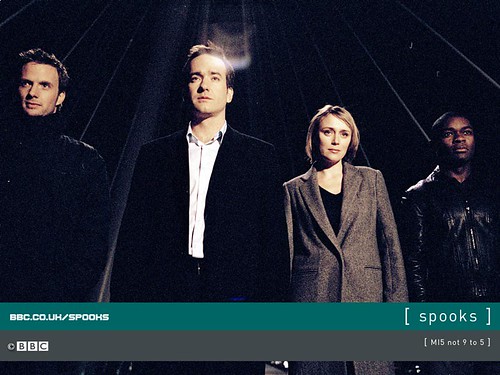
Featherstone's production company, Kudos, is probably best known on this side of the pond for A&E's MI-5 (which shows in Canada on BBC Canada under its original British Title, Spooks.) If you've only seen the show on A&E, I'd highly advise picking up the DVD's of Season One and Two (and soon, Three) as A&E cut out up to fifteen minutes per episode for commercials.

series3_team_4

I always liked Spooks/MI-5. I thought it was a bracing and refreshing look inside the world of Intelligence -- again, with a non-Amero-centric spin to it. Plus, the sexy American CIA Babe they had on the show, was, well...hot.

The Guardian article has a lot to say about the show that's quite illuminating. And one bit that flew right over my cultural head, but is remarkably cool -- and shows just how pressure cooker the TV game can be.

One of the favorite moments that made me sit up and take notice in MI-5 early on was a gruesome scene where someone was tortured using a deep fryer. It was raw and surprising as hell. What I didn't realize is that, if you were watching in the UK, it played as even more of a surprise, since the actress they killed was the biggest star in the cast...

The effect was spectacular: 334 viewers complained. Messageboards all over the BBC website continued to buzz even two weeks after the event. Some people thought Faulkner would return from the dead. Others suspected she had a twin sister. What seemed to have shocked them was not the brutality of the death - not especially graphic in the normal run of TV drama - but that Spooks did what television almost never does. It killed off one of its leads in the second episode of a long-running series. And in mainstream TV you just do not do that.

Jane Featherstone, joint managing director of Spooks production company Kudos,laughs and looks a tiny bit guilty. "The Lisa thing actually came about because David Wolstencroft was writing the outline for episode two and we just couldn't get it right," she admits. "We really needed the series to get the green light and the strongest story we had was in episode 13, where a woman got her head set on fire. We'd seen Lisa but we weren't sure we were going to cast her, the best story we had was the climax, we needed the commission, so what were we going to do? I said, let's move the most dramatic thing you've got to episode two and kill off the only actress the audience recognise and then you've got them hooked. We hoped ..."
There's two things that are really interesting there. First, the idea (that just didn't play here) that they killed off a big name (in the UK) in the episode made the show even more shocking for the home audience. I think that's brilliant. The American equivalent was probably the first episode of The Shield, where Vic Mackey's bonafides were forever established by the way he took out Reed Diamond -- a face who fans of the genre recognized from Homicide.

The other interesting bit there, at least to me, is the way that the pressures of the medium constantly force you to move things up. The creator of 24 is on record as saying that in that initial season, they had every intention of having the assasination attempt on David Palmer happen in the finale. Instead, it wound up coming halfway through Season One.

I've said it before. Lord knows I'll say it again. TV is a beast. And the beast must be fed.

Great article. Great series. Thanks to Lee Thomson's blog for the tip.

Keepin Downloads on the Down-Low & Other Tales From the Magical Land of Commerce

itmsnbcipods20051206

So I see Itunes has added NBC wares to their download store. Interesting, but, of course, ultimately useless to someone not living in the continental 48. (Okay, maybe Alaska and Hawaii can play too.)

But this reminds us all that, for all the hype surrounding the idea of downloading TV legally or not, the route to change is rapid. It's just not necessarily well-distributed yet.

In the UK, it seems, they're way further ahead with the idea of downloading TV. BBC has made announcements about having far more of its program archives online. Now they're squabbling over details - and here's an interesting twist - about how long it will be free (yes, free) or available after the broadcast...

That's right, USA, someone's further ahead. (The link is to an article at the Guardian Unlimited website, and I think registration is required...but it's free and that shouldn't be a hardship since it's a pretty great paper anyway. Especially you Americans. Get out. Live a little.)

For my take on the subject, look here.

In other revenue-stream news, the Christmas party episode of NBC's The Office aired last night, and in the midst of it there was a plot that revolved around the giving of an Ipod Video.
xmas_1
Now -- this was obviously a product placement plant by Apple. I mean, come on, the same week of the Itunes launch of ... wait for it ... downloadable Office episodes they feature an Ipod in a Secret Santa plot for the office party? Who'd a thunk it?

The thing is, in this case, it actually fit really well. The Ipod is a desirable gift. And in the context of the episode, the product featured really well both as an object of desire (so the sponsor's happy) and an object of conflict (so the show is served.)

I know that some pros and organizations are antsy. What does this mean? How can you ask writers to "work in" products? Should there be extra compensation for doing so? These are indeed important and thorny creative questions. And after long and careful consideration, the official position here in Sticksville is this:

Gimme.

I'll write it in. Whatever you want. Give me one. You got it. That should be the official WGA/WGC standard. You want a plot with an Ipod? Great. Send 'em over. There's four of us in the writers room.

Ford F-150, I'm talking to you, too.

Tampax?

Whatever. A man's got friends. Send over a case and we'll work it out. It's all good.

Now, where's my new Ipod?

Tuesday, December 6, 2005

Welcome to my Monkey Overlords!

Hidee-ho to any of you surfing in from the deliciously funny and informed world of the Kung Fu Monkey.

Here in Sticksville, we endeavor to deal with your TV writing and watching needs with a somewhat internationalist perspective. But not too international. After all, at the end of the day, Canada is roughly as exotic as New Jersey.

Poke around the hood a while, feel free to fling a little, drop a comment or a line and while you're at it, if you want, you could check out some of my favorite past posts.

What happens when you go up against bitter, bitter LOST fanboys? Well, it looks a lot like this or this.

Curious about the differences in the British, U.S., and Canadian systems of making TeeVee?

What about what it takes to be a writer?

It's kind of a lot like coming out.

Recently I've been working on a few new pilots. Which brings on the occasional bouts of sturm and drang.

We like to talk about books sometimes. And also about shows we're digging.

And sometimes we just get silly.

Anyway, welcome. Nice to have you. The sun is shining here in Toronto today, and when you can say that any day between November and April, that's a good day.

Monday, December 5, 2005

The Second Episode Problem

So. Pilots. They're easy.

Either it's a premise pilot -- the story of how your world comes to be (Rachel moves in with Monica after leaving her fiancee at the altar, and meets the Friends; Mackenzie Allen, after being advised not to take the oath, becomes President after the death of her strange-bedfellows running mate; Agent Mulder, a believer in all sorts of phenomena, is assigned a new skeptical FBI partner named Scully) or it's a story where you're dropped smack in the middle of your world (the first episodes of The West Wing, The Office, Trailer Park Boys, Corner Gas, Law & Order, etc.)

Both have their advantages -- It's simpler to hide exposition or convey information about the characters in a premise pilot, because the audience is learning things along with the characters. However, there's something to be said for being dropped right into the action. An interesting example of this is Firefly, where FOX ordered up a new, action-oriented pilot ("The Train Job") after they judged the original pilot too character-driven. Having seen the whole set, I can't necessarily say they were wrong. Remember -- the two other times Joss Whedon created a show, they came with built-in equity: Buffy's premise had been explored in a movie, and Angel brought two well-defined characters from Buffy.

And I lied in the first line, okay? It's not easy to write a pilot. It's actually really, really hard.

But in many ways, when you sit down and face the Second Episode Problem head on, deep and abject depression is the only intelligent, motivated and sane reaction.

It's like you managed to scale a mountain using only salad spoons and string cheese, and you have one moment at the peak, and then, what do you know -- there's another mountain lurking right behind it.

Where your pilot episode is about establishing the tone and the breadth of the world, your Second Episode has a different, and in many ways more daunting purpose:

It has to show both the sturdiness of your template, and the sustainability of the world.

First, sturdiness -- those characters you met briefly in the pilot? Let's see more of them, and let's note now how their conflicts are deeper, or funnier, or even more dramatic than we thought. Let's return to the main locations that we visited in the pilot and show how these locations are the right locations to promote dramatic conflict and situations.

Now, sustainability -- Let's show how a case, or a story, or a problem, or a funny situation, can just walk right in the door and demand to be dramatized. See how easy this is? See how lovingly the parameters were crafted in the pilot? Can't you just imagine seventy or one-hundred and sixty five stories in this exact vein -- all different, of course -- but not too different. The conflicts between your main characters? Those aren't going to get solved any time soon. They may even seem insurmountable. The endearing quirky bits you got hints of: well, just drop a few more nuggets that show how you haven't seen any of the true quirkiness, and by Dog when you do see it, it's going to be adorable and you're going to want to watch forever.

In short, the Second Episode is really where your story becomes a TV series.

Sturdiness + Sustainability = Template

The template is what happens every week; it's what your show delivers every episode: the type of story, tone, execution, humor, atmosphere, the whole magilla. In Veronica Mars, you know the template is that every week she's going to learn some small piece of the season-long mystery (big or small) while still solving the case-of-the-week. And the case-of-the-week will usually have something to say about the class or social differences lurking just under the brackish waters of Neptune High.

Sometimes you establish your template nice and tidy-like and then a few episodes in realize you're screwed. Smallville had a fun thing going with the Kryptonite-monster-of-the-week thing for a few weeks, but then realized, egad, that's going to get boring -- so they defaulted more to the rich cabinet of their mythos. (Which you don't have, by the way, because you're not splashing in the pool of one of the most beloved characters in the 20th century pop cultural pantheon.) Others have pointed out the limitations of House -- how many times can they screw up medically and almost kill the patient before they discover how the patient lied and make the correct diagnosis? (Actually, as it turns out, quite a few: say one thing about House -- their research is impeccable.)
House did a number of things in the first season to try and break out of their straitjacket: they brought in Chi McBride as an antagonist. That was never going to work, but it bought them a few weeks of arc momentum until they could twist and turn the character interactions enough to give them a more solid grounding. (They also refocused around House, thanks to the introduction of the ex.) House also manages to show how having a really good template does NOT mean tellling the same story the same way every week. The two episodes (so far) where they've messed around with story timeframes and flashback elements have been among the strongest in the series. Yet they did contain the elements of the template: there was a medical mystery, there was a personal involvement by one of the doctors, and there were plenty of interesting red herrings and half steps along the way.

Like House, Frasier figured out its template early on, and at least until the good writers left, found that it was pretty elastic. My favorite episodes of early-series Frasier were always the "farce" episodes. They were constructed differently than the others, which was why they only did one of those a season: but the elements of character conflict, interaction, humor -- all were the same. They just got to hang a different frame around it.

So establishing your template -- figuring out what happens every week -- does not have to be restrictive. The people who say it is, or does, simply don't have a sophisticated understanding of the television narrative form, or how films and TV series differ.

The problem is that when you sit down to start that process -- it's an almost mathematical experience. And I don't do well with Math.

Once, I was in a group with the Executive Producer of Frasier, Peter Casey, and he said that the secret he found when it came to write Frasier's second episode was this: don't count on anyone having seen the first episode. In other words, find a way to re-introduce all the major conflicts, plot points, and relationships all over again. If you watch Episode 2 of Frasier, you'll be amazed how similar it is to the pilot. The problem Frasier faces with his father is the same - it's still about Frasier not wanting to lose his freedom. The conflict with Niles is the same. You could easily start with Episode 2 and dive right in. And these days, you have to count on that if you want to survive. Even with a "Previously on..." you still have to make your second episode as accessible as the first. Assume the whole room watching is new.

I just sank a little lower in my chair.

Two of my projects now are at Episode 2 stage. (I was contracted for two scripts and a bible on each of these series.) Another project I'm writing is at Episode 1 -- and though it's in many ways the most challenging of the three, it's also easier to write for a few hours each day...even though I know that for that project, too, the daunting, dreaded Episode 2 lurks just over the horizon.)

For my half-hour comedy, the Episode 2 problem was this: I'm past the premise pilot. I have a core cast, and like Friends, in the pilot episode, I really was only able to concentrate on three of the ensemble. One of the seven characters didn't even appear until the last scene. (She was the comic relief, talked about but not seen for the first episode.)

When it came to craft Episode 2, I knew I had to focus more on the characters who were given short shrift in the pilot. Okay, so that dictates a certain kind of story. In the same way, I have to service the main couple, and the two comic relief guys whose plot was the thing that everyone responded to in the pilot. Whew.

This is a series about university students living in Rez. Episode One was the move in and the first days. I know that the show -- the template -- is about the ongoing problems and challenges of living together, so that immediately sparked one realization: I needed time to have past. It would be natural to pick up the story with the first interactions of all the characters -- but I already did that in the pilot, at least with some of the characters -- and that's not the show.

To be true to my template, then, the answer was simple: there is now a one-month gap between Ep 1 and 2. In Ep 1, they all move in, and in Ep 2 they've been living together a month.

So now I needed to find a plot that serviced the unserviced characters, and spoke to the premise of the characters having trouble getting along...

...and you know what? The demands of the template actually led me to a great, natural plot. I think that Ep 2 of this series is stronger than Ep 1. It's certainly more representative of what the concept and premise can be.

Episode 2 thinking is all about strategizing up front. If you've done it right, hopefully once you're writing script you're confident in what you need to accomplish.

With my hour drama -- I'm still at the pitch. And the pitch has been a bitch. I made a silly mistake with the first iteration: I focused the story around the guest charater, instead of the principals. My understanding of the principals was evolving at the time, but once that was pointed out to me, and I engaged in the requisite ritual self-flagellation, I realized that the fix wasn't really all that difficult.

My story -- my template -- needs to be about my characters being devilishly clever and manipulating everyone around them to get what they want. Sounds simple, except, of course, for the fact that I'm writing people who are definitely, without a doubt, more clever than I am.

I want a writing staff so much right now I could just cry.

Anyway, one of the other weird things about the Second Episode Problem is the fact that you live with the first episode so much longer. In both the cases I've cited above, there's been more than two years to get to draft on the Pilot. Then you need to come up with Episode Two within a month or two. That's still more time than you're going to have once the bastard goes into production (sound of Denis knocking wood) but it's still a strange, whiplash experience nonetheless.

I remember years ago I used to go to tapings of the great Canadian TV comedy series Kids in the Hall (you can still hear me laugh on about half the episodes. I'm a loudlaugher.) Here's the story that terrified me beyond belief: The Kids gigged in clubs here in Toronto for seven years. Seven years, building material and a catalogue of proven, killer sketches. Then they did season one. And at the end of season one, the cupboard was bare. Season One writing time: seven years. Season Two: Three Months.

That's why you need to do the math, and think through the template. The beast must be fed, and the cupboard, sadly, well...it's always, always bare.

UPPITY DATE: Serendipity alert: as I finished this post and hit "publish," who should walk into my neighborhood coffee shop but Mark McKinney from the Kids in the Hall

So I promptly crushed his head

One Pilot I'll Be Keeping My Eye On...

One of my favorite recent shows was Worldwide Pants' ED.

During its three-year run on NBC, I thought the show was a very entertaining, good natured show that successfully mixed comic and dramatic elements. It had a great cast, led by a Canadian actor who I think is the closest thing I've seen to a genuine Jimmy Stewart type, Tom Cavanagh, and the lovely, never-better-than-in-this-role Julie Bowen. Together, those two executed a pretty-well executed running "will they or won't they" romantic subplot. The show also had an intriguing combo of offbeat lawyering and small-town weirdness about it.

Plus, they filmed it close to where I lived when I was a kid.

ED was one of my specs a couple years ago. I actually quite liked that one. Too bad it's fishwrap now. Oh well.

The big news is that the creative team behind ED, former Late Show writers Rob Burnett and Jon Beckerman, have just gotten a Pilot with ABC. The pilot will star Donal Logue, who's never yet managed to transfer the excellence of his Tao of Steve performance to Television.

This is one that I'll be rooting for.

Link to the story in the Hollywood Reporter.